TAP top app download banner
theAsianparent
theAsianparent
Product Guide
  • Together Against RSV
  • Pregnancy
  • Parenting
  • Child
  • Feeding & Nutrition
  • Education
  • Lifestyle
  • Events
  • Holiday Hub
  • Aptamil
  • TAP Recommends
  • Shopping
  • Press Releases
  • Project Sidekicks
  • Community
  • Advertise With Us
  • Contact Us
  • VIP
Login
    • Articles
  • Together Against RSVTogether Against RSV
  • PregnancyPregnancy
  • ParentingParenting
  • ChildChild
  • Feeding & NutritionFeeding & Nutrition
  • EducationEducation
  • LifestyleLifestyle
  • EventsEvents
  • Holiday HubHoliday Hub
  • AptamilAptamil
  • TAP RecommendsTAP Recommends
  • ShoppingShopping
  • Press ReleasesPress Releases
  • Project SidekicksProject Sidekicks
  • CommunityCommunity
  • Advertise With UsAdvertise With Us
  • Contact UsContact Us
  • VIPVIP
    • Community
  • Poll
  • Photos
  • Food
  • Recipes
  • Topics
  • Read Articles
    • Tracker
  • Pregnancy Tracker
  • Baby Tracker
    • Rewards
  • RewardsRewards
  • Contests
  • VIP ParentsVIP Parents
    • More
  • Feedback

Privacy PolicyCommunity GuidelinesSitemap HTML

Download our free app

google play store
app store

More Boys Are Diagnosed With Cancer Than Girls Worldwide... Here's Why

4 min read
More Boys Are Diagnosed With Cancer Than Girls Worldwide... Here's Why

There’s no reason why more boys should be diagnosed than girls.

Like most things, cancer diagnosis is not equal for men and women.

In adults, sexual hormones, dietary habits, exposure to carcinogens, smoking and alcohol consumption combine to give rise to a situation where more men than women are diagnosed with cancer globally.

Worldwide, 7.4 million cancers are diagnosed in men and 6.6 million are diagnosed in women. Lung, prostate and colorectal cancer are the most common types among men, whereas breast, colorectal and lung cancer are the top three among women.

But the factors that lead to this gender difference in cancer diagnosis all affect us later in life, and should not apply to children. Yet the present data shows that more boys than girls are diagnosed with cancer worldwide.

The same risk

Gender difference in cancer

Image source: iStock

Survival rates of childhood cancers have increased dramatically in high-income countries. More than 80% of child cancer patients are expected to survive at least five years in the United States and UK. Unfortunately, survival rates are still very poor in many developing countries.

There is no obvious reason for a distinction in cancer incidence in childhood. Boys and girls are at similar genetic risk for developing cancer unless sex chromosomes are involved.

Sex hormones do not kick in until our mid-teens, meaning breast cancer or prostate cancer are extremely rare among children. Children are most affected by leukaemia, lymphoma, brain tumours and embryogenic tumours such as neuroblastoma, retinoblastoma, Wilms tumor and rhabdomyosarcoma.

Boys and girls usually share the same environment and consume the same food; there is no occupational exposure to external carcinogens at these ages, and tobacco or alcohol consumption is low or non-existent.

Because the risk factors for cancer development are similar, we should see a similar incidence of cancer among boys and girls, with an expected male to female ratio of close to one – that is, for every boy who gets cancer, one girl should too.

Yet an analysis of data from the International Agency for Research on Cancer (IARC) shows this is not true.

Worldwide gender difference in cancer diagnosis

IARC estimates that every year, 163,000 children between ages 0 and 14 are diagnosed with cancer worldwide. Of these, 94,000 are boys and 68,000 are girls. This leads to a global ratio of 1.37 – so four boys are diagnosed with cancer for every three girls.
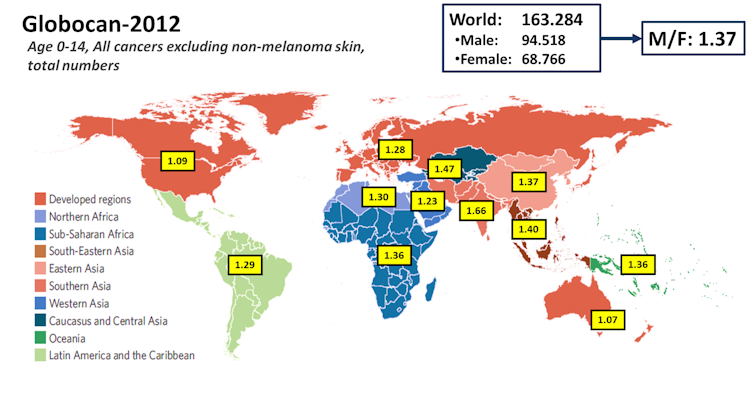
Gender difference in cancer

Gender distribution of childhood cancers worldwide.

But it’s not the same story everywhere. The male-to-female ratio is nearly one-to-one in high-income regions, including America and Australia. In Europe, the Middle East and Latin America it is less than 1.3.

In Southern Asia, however, the rate is higher than 1.6.

Gender discrimination

The reasons of this gender imbalance are not yet known. But we have some clues. As we have seen poorer countries tend to have more of a gender imbalance in childhood cancers.

These rates also correspond with levels of gender equality. International gender equality rankings show that in North America, Australia and Europe, women and men are more equal than in, say, Southern Asia.

A previous study, published in 2001, found a similar diagnosis gap between boys and girls. The authors concluded:

Elevated sex ratios in developing countries reflect the socio-economic level of the society more than the nature and aetiology of the disease.

So the most likely reason for the gap in many countries is that girls are less likely than boys to be referred to a doctor when they fall ill.

If this is the reason, it should be accepted as another sign of gender discrimination against girls. And the fact that we see such a gender imbalance in cancer diagnosis between boys and girls requires urgent attention not only from scientists and researchers, but also health-care providers and governments.

Taking action

More Boys Are Diagnosed With Cancer Than Girls Worldwide... Heres Why

Image source: iStock

The Sustainable Development Goals, a set of ambitious targets adopted by the United Nations in 2015, mandate that the world must achieve gender equality by 2030. This is an enormous task.

If the UN aims to end all forms of discrimination against women and girls everywhere, it must address the fact that cancer is not being diagnosed in girls at the same rate as boys.

All efforts should be mobilised to increase the access of girls to medical care. This will increase the rates of cancer diagnosis and allow girls to provide proper treatment, eventually closing the gap with boys.

Yavuz Anacak, Radiation oncologist, Ege University

This article is republished from The Conversation under a Creative Commons license. Read the original article.

ALSO READ:

15 Cancer Signs in Children That You Might Be Ignoring

Understanding The Most Common Childhood Cancers: A Comprehensive Guide For Parents

Leukaemia in Children: Mum Shares Important Warning Signs!

More Boys Are Diagnosed With Cancer Than Girls Worldwide... Heres Why

Partner Stories
Commentary: Parents, Take Note: Leading Cause of Infant Hospitalisation Is RSV, Not the Common Cold
Pre-Myopia Assessment: How Parents Can Reduce Their Child’s Risk of Myopia Before It Becomes Irreversible
Worried About Your Child’s Oral Health? 6 Signs Your Child Should See an Orthodontist
Is Your Child’s Tummy Telling You Something: 6 Signs of Poor Gut Health in Kids

Got a parenting concern? Read articles or ask away and get instant answers on our app. Download theAsianparent Community on iOS or Android now!

img
Written by

The Conversation

  • Home
  • /
  • Health
  • /
  • More Boys Are Diagnosed With Cancer Than Girls Worldwide... Here's Why
Share:
  • Commentary: Parents, Take Note: Leading Cause of Infant Hospitalisation Is RSV, Not the Common Cold
    Partner Stories

    Commentary: Parents, Take Note: Leading Cause of Infant Hospitalisation Is RSV, Not the Common Cold

  • Pre-Myopia Assessment: How Parents Can Reduce Their Child’s Risk of Myopia Before It Becomes Irreversible
    Partner Stories

    Pre-Myopia Assessment: How Parents Can Reduce Their Child’s Risk of Myopia Before It Becomes Irreversible

  • When Time Affects Both Parents: What 2025 Research Really Tells Us About Fertility and Age

    When Time Affects Both Parents: What 2025 Research Really Tells Us About Fertility and Age

  • Commentary: Parents, Take Note: Leading Cause of Infant Hospitalisation Is RSV, Not the Common Cold
    Partner Stories

    Commentary: Parents, Take Note: Leading Cause of Infant Hospitalisation Is RSV, Not the Common Cold

  • Pre-Myopia Assessment: How Parents Can Reduce Their Child’s Risk of Myopia Before It Becomes Irreversible
    Partner Stories

    Pre-Myopia Assessment: How Parents Can Reduce Their Child’s Risk of Myopia Before It Becomes Irreversible

  • When Time Affects Both Parents: What 2025 Research Really Tells Us About Fertility and Age

    When Time Affects Both Parents: What 2025 Research Really Tells Us About Fertility and Age

Feed

Feed

Get tailored articles about parenting, lifestyle, expert opinions right at your fingertips

Poll

Poll

Participate in interesting polls and see what other parents think!

Photos

Photos

Share the photos of loved ones in a safe, secure manner.

Topics

Topics

Join communities to bond with fellow mums and dads.

Tracker

Tracker

Track your pregnancy as well as baby’s development day-by-day!

theAsianparent

Download our free app

Google PlayApp Store

Mums around the world

Singapore flag
Singapore
Thailand flag
Thailand
Indonesia flag
Indonesia
Philippines flag
Philippines
Malaysia flag
Malaysia
Vietnam flag
Vietnam

Partner Brands

Rumah123VIP ParentsMama's ChoiceTAP Awards

© Copyright theAsianparent 2026 . All rights reserved

  • About Us
  • Privacy Policy
  • Terms of Use
  • Sitemap HTML
  • Tools
  • Articles
  • Feed
  • Poll

We use cookies to ensure you get the best experience. Learn MoreOk, Got it

We use cookies to ensure you get the best experience. Learn MoreOk, Got it