Long before sunrise on the day of Thaipusam, the courtyard of Sri Srinivasa Perumal Temple on Serangoon Road is already packed: shaved heads, yellow cloth, drums, and men bent under steel frames taller than they are. By mid-morning the procession stretches for kilometres, and thousands of pots of milk are moving slowly towards Tank Road. Whether your family observes Thaipusam or you’re simply trying to explain it to a curious seven-year-old, it’s a festival that rewards a little understanding.
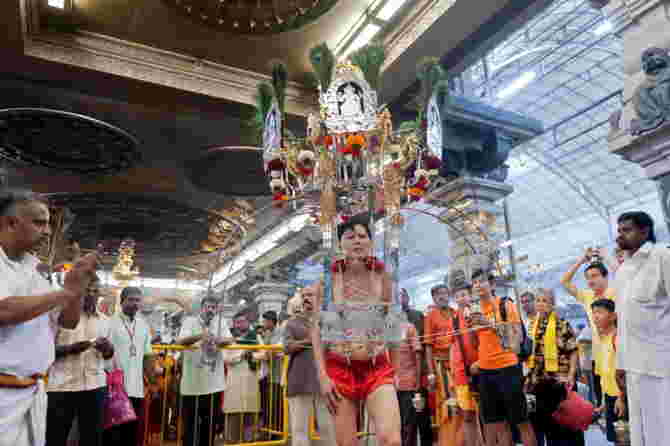
Thaipusam is a Hindu festival honouring Lord Murugan, marked by a procession of devotees carrying milk pots and kavadis from Sri Srinivasa Perumal Temple to Sri Thendayuthapani Temple. It falls on the full moon of the Tamil month of Thai, in late January or early February.
It’s a festival of vows fulfilled and thanks given, and the endurance on show is the point: mind over matter.
What Thaipusam is
Thaipusam is celebrated by Hindus, mostly of Tamil heritage, in honour of Lord Murugan, also known as Lord Subramaniam, the god of virtue, youth and power and the destroyer of evil. It marks the day his mother, the goddess Parvati, is said to have given him a divine spear to vanquish a demon. Devotees use the day to give thanks and to fulfil vows made when a prayer was answered, an illness passed, or a wish granted.
In Singapore the heart of the festival is a procession, on foot, of devotees carrying offerings the roughly three to four kilometres from the Sri Srinivasa Perumal Temple on Serangoon Road to the Sri Thendayuthapani Temple on Tank Road.
The kavadi and the milk pots
Two kinds of offering define the procession:
- The paal kudam, or milk pot. Most devotees carry a pot of milk on the head, an offering to Lord Murugan. In 2026, more than 19,000 devotees carried milk pots, and temples opened extra slots to meet demand.
- The kavadi. The word means “sacrifice at every step”. It’s a semi-circular frame of steel or wood, carried on the shoulders, decorated with peacock feathers and flowers. The most striking are the vel kavadi, held to the body by hooks and skewers piercing the skin, and even spears through the cheeks and tongue. A kavadi can weigh up to around 40kg and stand several metres tall. In 2026, 349 devotees bore kavadis.
Devotees say the piercings, done in a prayerful, trance-like state after long preparation, aren’t painful in the way onlookers imagine. Carrying the kavadi is an expression of devotion and endurance, the triumph of spirit over the body.
The preparation
Carrying a kavadi isn’t a spur-of-the-moment act. Devotees prepare for weeks, often a month, beforehand. They keep a strict vegetarian diet, practise celibacy, and focus the mind through prayer, because a pure body and a calm mind are held to be essential to bear the kavadi without harm. The preparation is as much a part of the vow as the procession itself.
When it happens
Thaipusam falls on the full moon in the Tamil month of Thai, which places it in late January or early February. It was on 1 February in 2026. Because it follows the lunar calendar, the date moves each year, so check the Hindu Endowments Board’s dates when planning around it. In Singapore, Thaipusam isn’t a gazetted public holiday, so it won’t appear on the list of Singapore public holidays and long weekends, though it’s a day of great significance for the Hindu community.
Its place in the calendar often puts it within days of Chinese New Year, so many households are juggling two sets of preparations at once, from temple slots to figuring out where to buy Chinese New Year clothes before the shops sell out of the good sizes.
Watching with children
Thaipusam is open to all, and watching the procession is a real cultural experience for a Singapore child. A few things help:
- Go early or late. The procession runs through the day and into the night. Mornings and evenings are cooler and less crowded than the midday peak.
- Explain it first. A child who knows the piercings are a chosen act of devotion, done without pain by prepared devotees, watches with respect instead of fear.
- Be respectful. This is an act of worship. Keep a polite distance from devotees, ask before photographing people closely, and follow the marshals.
- Expect road closures. Streets along the route close, so plan your travel and use the MRT.
It’s a chance to teach children about one of the communities that make up Singapore, and about faith, endurance and gratitude, in a way no textbook manages. Older kids often find the idea of a vow easier to grasp when it’s linked to something they already do at school, such as writing Teachers’ Day messages and gift rules around thanking someone properly: gratitude with effort behind it.
Common questions
What is Thaipusam?
A Hindu festival honouring Lord Murugan, when devotees give thanks and fulfil vows by carrying milk pots and kavadis in a procession. It celebrates devotion and the triumph of mind over body.
When is Thaipusam in Singapore?
On the full moon of the Tamil month of Thai, in late January or early February. It fell on 1 February in 2026. The date shifts each year with the lunar calendar, so check the Hindu Endowments Board.
What’s a kavadi?
A decorated semi-circular frame carried on the shoulders during Thaipusam. The word means “sacrifice at every step”. Some are attached to the body with hooks and skewers through the skin, and they can weigh up to about 40kg.
Why do devotees pierce their bodies?
As an act of devotion and a fulfilled vow. After weeks of preparation and in a prayerful, focused state, devotees say the piercings aren’t painful. It expresses the triumph of spirit over the body.
Where is the Thaipusam procession in Singapore?
It runs roughly three to four kilometres from Sri Srinivasa Perumal Temple on Serangoon Road to Sri Thendayuthapani Temple on Tank Road. Expect road closures along the route.
Can children watch Thaipusam?
Yes. It’s open to all and a rich cultural experience. Explain the meaning first, keep a respectful distance, and go in the cooler morning or evening to avoid the crowds.
If you go this year
Check the Hindu Endowments Board for the date, pick a cooler hour, and give your children the context before you leave the house. Then stand at the roadside and watch a man walk four kilometres under 40kg of steel because he promised he would. Explaining that to a child is harder than explaining any public holiday, and far more worth doing.
More on Singapore’s festivals
Festival details and 2026 participation figures are from the Hindu Endowments Board and contemporary reports. Dates follow the Tamil lunar calendar, so confirm the current year’s date with the HEB.


 Together Against RSV
 Pregnancy
 Parenting
 Child
 Feeding & Nutrition
 Events
 Aptamil
 Shopping
 Project Sidekicks
 Community
 Advertise With Us
 Contact Us
 VIP
 Rewards
 VIP Parents

