Mums and dads, it’s exam season again in Singapore! If your child is sitting for the PSLE, we know the mix of excitement and anxiety you’re probably feeling. For many parents, the stress almost feels like you are the one taking the exam instead of your child.
It’s natural to worry. After all, the Primary School Leaving Examination (PSLE) is the first major academic milestone in your child’s life. Many kids don’t know what to expect, and parents can’t help but wonder: “Will my child be able to handle the pressure?”
One of the most effective ways to prepare is by using PSLE past year papers. These papers not only help students get familiar with the exam format, but also train them to manage time, understand question patterns, and before the big day.
In this guide, we’ll answer some of the most common questions parents ask about the PSLE. And to make things easier, we’ve also included a list of PSLE past year papers free download links at the end of this article.
What Does PSLE Stand For?
The Primary School Leaving Examination (PSLE) is an annual national test taken by all Primary 6 students in Singapore. It has been a key part of the education system since the 1960s, designed to assess whether students are ready to move on to secondary school.
Based on their PSLE results, students are placed in appropriate secondary school courses that match their academic strengths and learning pace.
The PSLE is jointly administered by the Ministry of Education (MOE) and the Singapore Examinations and Assessment Board (SEAB).
Understanding the PSLE Scoring System
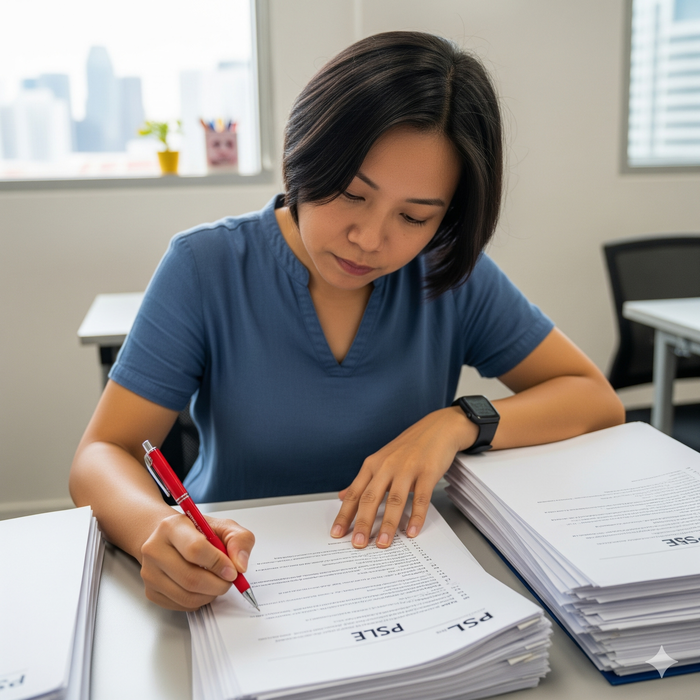
PSLE Past Year Papers and Free Exam Resources For Download
In recent years, the PSLE scoring system has been revamped to reduce stress on students and shift the focus away from excessive competition. Instead of the old T-score system, students are now graded using Achievement Levels (ALs).
-
Each subject is scored from AL1 (best) to AL8 (lowest).
-
The total PSLE score is the sum of all four subjects, with possible scores ranging from 4 to 32.
This new system means:
-
Less fine differentiation between students’ results.
-
More students qualifying for the same cut-off points.
-
Wider school choices based on interests, CCAs, and special programmes.
In addition to written exams, schools also place more weight on holistic assessments such as group projects, presentations, and class tests.
The goal is to help children discover their strengths, nurture their confidence, and ensure that their secondary school journey matches their pace of learning.
PSLE Dates 2025
The Primary School Leaving Examination (PSLE) is one of the biggest milestones for every Primary 6 student in Singapore. It not only marks the end of their primary school journey but also determines their placement in secondary school. Because of its importance, it’s crucial for parents and children to start preparing months in advance.
One effective way to do this is by planning revision around the official exam schedule. Knowing the dates helps families manage study time better, reduce last-minute stress, and even slot in practice sessions using PSLE past year papers.
Here’s the full timeline for the PSLE 2025 examinations:
-
Oral Examinations: Wednesday, 13 August – Thursday, 14 August 2025
-
Listening Comprehension: Tuesday, 16 September 2025
-
Written Examinations: Thursday, 25 September – Friday, 26 September, and Monday, 29 September – Wednesday, 1 October 2025
-
Marking Exercise: Monday, 13 October – Wednesday, 15 October 2025
-
Results Release (Tentative): Late November 2025 (expected between 24–26 November)
When Will PSLE Results Be Released?
The PSLE results for 2025 are expected to be released in late November, typically within the last week of the month. Based on the official timetable, parents can anticipate the results to be announced between 24 and 26 November 2025.
The exact date will only be confirmed by the Ministry of Education (MOE) and the Singapore Examinations and Assessment Board (SEAB) after the marking and processing of scripts are completed.
How To See PSLE Results

PSLE Past Year Papers and Free Exam Resources For Download
Students who sat for the national examinations have two main ways to check their PSLE results:
-
Online (via Singpass or SEAB portal)
On the day of release, candidates can log in to the results release system using their Singpass or a system-generated password provided by SEAB.
-
Students without Singpass will receive an email with their login credentials a few days before the release.
-
This option allows parents and children to view results from the comfort of home, which many families now find convenient.
-
In person (at school)
Students may still collect their results in school. To ensure a safe and personal experience, results are usually handed out in individual classrooms instead of large gatherings in school halls.
PSLE School Choice and Cut-off Points
Once results are released, families move on to the next big step, choosing a suitable secondary school. Each school has an indicative cut-off point (COP) based on previous years’ PSLE scores.
-
Elite schools like Raffles Institution and Raffles Girls’ School (Secondary) typically admit students with scores between 4 and 6.
-
Popular schools such as Anderson Secondary School usually fall between 4 and 10, while Crescent Girls’ School’s range is around 6 to 11.
-
Neighbourhood schools like Gan Eng Seng School may have ranges of 7–15 for Express, 21–23 for Normal Academic, and 25–26 for Normal Technical.
-
For Singapore Chinese Girls’ School, the indicative range is 5–9 points for affiliated students and 8–17 points for non-affiliated students in the Express O-Level track. Its Integrated Programme often accepts students in the 4–8 range.
These ranges give families an idea of what to expect, though they may vary slightly each year depending on the overall cohort’s performance.
Parents are encouraged to balance aspiration with practicality when choosing schools, looking beyond COPs to also consider location, CCAs, and school culture. Practising with psle past year papers during the preparation phase can help students aim for their target schools with more confidence.
What To Do After PSLE?
The Primary School Leaving Examination (PSLE) is finally over! Both students and parents can finally take a well-deserved breather after months of preparation and stress. Many children will happily declare that they don’t want to see another practice assessment book anytime soon and that’s completely normal.
As a parent, you probably feel the same relief. But while rest is important, this long break before secondary school is also a golden opportunity for growth, discovery, and gentle preparation for the next academic stage.
Here are some meaningful ways to help your child transition after the PSLE:
1. Explore New Interests or Skills
With exams behind them, your child now has more time to pursue hobbies and passions. Encourage them to try something new, whether it’s sports, music, coding, or even simple life skills like cooking. Picking up new activities helps develop creativity, resilience, and soft skills that will be useful in secondary school and beyond.
2. Keep Learning at a Relaxed Pace
After months of intensive revision, it’s good to keep your child’s brain active without overwhelming them. Learning doesn’t have to mean more worksheets or test prep. It can come in fun forms like:
-
Brainteasers and puzzles for critical thinking.
-
Family outings that encourage experiential learning.
-
Reading books outside of the school curriculum to expand vocabulary and imagination.
Maintaining this gentle rhythm makes it easier for your child to adjust when the more challenging secondary school curriculum begins.
3. Prepare for Secondary 1
Some parents choose to enrol their children in bridging or introductory programmes that help them get familiar with Secondary 1 subjects. This can ease the transition into a faster-paced academic environment.
You don’t have to dive straight back into full-on exam prep. Occasional practice with selected psle past year papers can help reinforce key concepts before moving on to more advanced material.
PSLE FAQs: What To Look Out For?
Registration and Withdrawal
1. Can I withdraw from the PSLE?
Please inform your school principal should you wish to withdraw from the PSLE.
2. What subjects should I register for the PSLE?
The subjects offered at PSLE are shown below:
Standard subjects: English, Mathematics, Science, Mother Tongue Languages (Chinese/Malay/Tamil), Non-Tamil Indian Language), Higher Mother Tongue Languages (Chinese, Malay and Tamil).
Foundation subjects: English, Mathematics, Science, Mother Tongue Languages (Chinese, Malay, Tamil) and Non-Tamil Indian Languages.
Please refer to SEAB website for the syllabus information. Registration for the PSLE is done through your school.
3. Will the examination fees be refunded if I withdraw from the PSLE?
There is no refund of examination fees on withdrawal.
4. Who can sit the PSLE?
Students who are studying in government/government-aided/approved institutions in Singapore are eligible to sit the PSLE when they reach the Primary 6 level.
5. Is there a maximum age which a student can take the PSLE?
All students can sit for the PSLE at the end of Primary 6. For more details, visit the Ministry of Education (MOE) website.
Conduct of Examination
1. What happens if I fall sick during the PSLE and do not sit for the examination?
You should submit your medical documents to the Singapore Examinations & Assessment Board through your school if you fall sick.
2. What happens if I fall sick during the PSLE but I sit for the examination?
You should submit your medical documents to your school. All applications for review should be made through the school.
3. What happens to my results if I do not turn up for the examination?
For those subject(s) that you have missed during the PSLE, you will be given the grade – Ungraded.
Dictionary, Calculator, Correction Fluid or Tape

PSLE Past Year Papers and Free Exam Resources For Download
1. Is correction fluid/tape allowed?
You are advised not to use correction fluid/tape in the national examinations. There were instances where the use of correction fluid affected the legibility of scripts.
The application of correction fluid/tape has also led to answers being left incomplete.
Furthermore, answer scripts with correction fluid/tape may be damaged if scanning is required; or if the fluid is not dried, the pages may get stuck together.
2. Where can I find the list of approved dictionaries?
The list of approved dictionaries can be found on SEAB’s website.
3. Can I use a dictionary that is not on the list of approved dictionaries? The name of the dictionary is different but it is from the same publisher.
Candidates are required to use the dictionaries listed in the approved dictionary list issued by SEAB. The list is also available on the website.
4. Where can I find the list of approved calculators?
The list of approved calculators can be found on SEAB’s website at https://www.seab.gov.sg/approved-calculators/
5. Can I bring more than one calculator and/or dictionary into the examination hall?
SEAB does not restrict the number of approved calculators and e-dictionaries that candidates can bring for use at national examinations.
Candidates may bring in more than one approved calculator and e-dictionary for national examinations.
Access Arrangements
1. How do I apply for access arrangements?
Application for access arrangements must be done through your school. Please approach your school for the application procedures.
Results Slips and Certificates
1. Can I authorise someone to collect the PSLE results on my behalf?
Yes, you can. Please inform your school in advance and confirm the arrangement with the school.
2. I have lost my PSLE Certificate. How can I get a replacement certificate?
The PSLE Certificate is issued only once and cannot be reprinted. If you have lost it, you may purchase a Statement of Results from the Ministry of Education (MOE) Customer Service Centre.
MOE Customer Service Centre:
1 North Buona Vista Drive, Singapore 138675
Operating Hours:
Fees:
3. I have lost my result slip. How can I get a replacement result slip?
You can purchase a “Statement of Results” from the Ministry of Education Customer Service Centre at 1 North Buona Vista Drive, Singapore 138675.
- Operating hours:
- 8:30 am to 5:30 pm (Mon-Fri)
- 8:30 am to 12:30 pm (Sat)
- Contact number: 6872-2220
- Costs for “Statement of Results”:
- S$10.00 per copy
- They will charge $2.00 and $5.00 if you would like the Statement of Results mailed to your local address or overseas address respectively.
4. What happens if there is a spelling error in the personal particulars (like Statutory Name, Hanyu Pinyin Name, Identification No. etc) in my result slip and/or PSLE Certificate?
Please notify your school of the error. The relevant authorities will correct the mistake on your PSLE certificate. An administrative fee may apply.
5. What are the dates for the PSLE Marking Exercise in 2025?
The PSLE Marking Exercise for 2025 is scheduled from Monday, 13 October to Wednesday, 15 October 2025. During this time, all primary school students are on holiday while teachers grade exam scripts.
Appeal For Review of Results
1. Can I make an appeal for a review of my national examination results?
Yes, you may appeal for a review of results through your school immediately after obtaining your national examination results.
The appeal must be submitted to SEAB through the school by the closing date. There will be an appeal fee for each subject.
2. How do I make the choice of my secondary schools if I am waiting for the outcome of my appeal for review of my PSLE results?
You should make your choice of secondary schools based on your existing results and the course posted.
3. How long does it take to process an appeal for review of results?
The process for the review of results usually takes one month.
Posting to Secondary Schools
1. What help does the Ministry give students to make their choice of secondary schools?
The Ministry of Education’s website provides Primary Six students with the considerations when making the choices their Secondary Schools.
2. What is the cut-off score for entry to the various secondary school courses?
The cut-off aggregate score for each secondary school course may vary from year to year.
3. What’s the process to stream students into the various courses in secondary schools?
Students stream into the various courses in secondary schools based on their PSLE aggregate scores.
What Is A Good PSLE Score?
Under the current Achievement Level (AL) scoring system, the lower the total score, the better. The scale ranges from 4 (top) to 32 (lowest clear pass).
With Singapore’s transition to Full Subject-Based Banding (Full SBB), the traditional streams, Express, Normal (Academic), and Normal (Technical) have been replaced from 2024 onwards. Now, students are grouped into Posting Groups (1 to 3) for Secondary 1 placement, based on their overall PSLE score and scores in English and Mathematics.
Here’s the PSLE score mapping to Posting Groups and subject-level readiness:
|
|---|
| PSLE Total Score |
Posting Group |
Default Subject Level at Sec 1 |
| 4 – 20 |
Group 3 |
G3 (prev Express) |
| 21 – 22 |
Group 2/3 |
G2 or G3 |
| 23 – 24 |
Group 2 |
G2 |
| 25 |
Group 1/2 |
G1 or G2 |
| 26 – 30* |
Group 1 |
G1 (prev N(T)) |
*Requires AL7 or better in both English and Mathematics
In practical terms:
-
A score of 10 or lower is considered excellent and can open doors to top schools and programmes.
-
A score between 4 and 20 positions your child firmly within the top band (Group 3), offering strong opportunities for academic excellence and broader subject choices.
What Happens If You Fail PSLE?
Though the old Express, N(A), and N(T) streams have been officially phased out by 2024, the system remains flexible to support your child’s growth:
-
Students are placed into Posting Groups 1 to 3 based on their PSLE scores. However, schools can adjust subject levels as students demonstrate their strengths. This allows capable students to take on more challenging subjects irrespective of their initial posting group.
-
Continuous assessments in Secondary 1 and beyond ensure that students can be moved up level-wise and challenge-wise where fit.
So even if your child doesn’t hit their target Posting Group right away, the system is designed to support their development, with flexibility built-in for future progression.
Where Can I Get Past PSLE Papers?
There are past years’ exam papers for the PSLE and GCE-Level available for purchase. Here are the names and phone numbers of our authorised publishers:
|
|---|
|
Publisher
|
Address
|
Contact
|
|
Shing Lee Publishers Pte Ltd
|
120 Hillview Avenue
#05-07
Kewalram Hillview
S(669594)
|
Tel: 67601388
Fax: 67625684
Email: [email protected]
Contact Person: Agnes Sim / Edmund Leong / Benny Chu / Chris Loh / Willy Neo
|
|
Educational Publishing House Pte Ltd
|
15 Serangoon North
Ave 5
S(554360)
|
Tel: 64629603
Fax: 64652205
Email: [email protected]
Contact Person: Jenny Wong
|
Where to Buy PSLE Past Year Papers?
Parents and students can purchase PSLE past year papers through several official and reliable channels. Schools may provide access to practice papers, while major bookstores such as Popular Bookstore and Times Bookstores also sell compilation books with past questions and answers.
For more updated and official practice resources, you can also buy from the Singapore Examinations and Assessment Board (SEAB) online store. Many educational websites and tuition centres likewise offer curated sets of past year papers to help students prepare more effectively.
PSLE Past Year Papers: Primary School Test Papers from Top Schools in Singapore
Well… whether or not we believe in the saying that practice makes perfect, it’s wise to go into a battle knowing what you’re in for.
To be better ready for PSLE, here are some past P6 exam papers for your child to practice and hone their skills. Good luck!
Most Downloaded P6 Past Year Papers
*Updated 2024.
- P6 Maths 2024 SA2 – Nanyang Primary
- P6 Maths 2024 SA2 – ACS Primary
- P6 Maths 2024 SA2 – Rosyth
- P6 Maths 2014 SA1 – Nan Hua
- P6 English SA1 2018 – Anglo Chinese
- P6 2015 Prelims Science – Raffles Girls
- P6 2015 Prelims Maths – Christian Brothers
- P6 2015 Prelims Maths – Raffles Girls
- P6 2015 Prelims Maths – Nanyang
- P6 2015 Prelims Maths – Henry Park
- Primary 6 English SA2-B 2011 Raffles Girls
- P6 2015 Prelims Maths – Temasek Primary
- P6 Maths 2014 SA2 – Tao Nan
PSLE Past Year Papers: According to Subjects
English
- P6 English SA2 2024 – Nan Hua
- P6 English SA2 2023 – ACS Primary
- Primary 6 English SA2 2022 – Rosyth
- P6 English SA2 2019 – Singapore Chinese Girls
- P6 English SA2 2019 – Raffles Girls
- P6 English SA2 2019 – Rosyth
- P6 English SA2 2019 – Nanyang
- P6 English SA2 2017 – Singapore Chinese Girls
For more English examination papers, please visit here.
Chinese
- P6 Chinese SA2 2024 – Catholic High
- P6 Higher Chinese SA2 2023 – Nan Hua
- P6 Chinese SA2 2022 – Nanyang
- P6 Chinese SA2 2019 – Nan Hua
- P6 Chinese SA2 2019 – Nanyang
- P6 Chinese SA2 2019 – Ai Tong
- P6 Chinese SA2 2019 – Singapore Chinese Girls
- P6 Chinese SA2 2018 – Catholic High
- P6 Chinese SA2 2018 – Pei Hwa
- P6 Higher Chinese SA2 2017 – St Hildas
- P6 Higher Chinese SA2 2017 – Catholic High
- Primary 6 Chinese SA2 2016 – Henry Park
- P6 Higher Chinese SA2 2014 – Tao Nan
For more Chinese examination papers, please visit here.
Maths
- P6 Maths 2024 SA2 – Henry Park
- P6 Maths 2023 SA2 – Ai Tong
- Primary 6 Maths 2022 SA2 – Nan Chiau
- P6 Maths 2019 SA2 – Ai Tong
- P6 Maths 2019 SA2 – Maha Bodhi
- P6 Maths SA2 2019 – CHIJ
- P6 Maths SA2 2018 – Methodist Girls
- P6 Maths SA2 2018 – Red Swastika
- P6 Maths SA2 2018 – River Valley
- P6 Maths SA2 2017 – Raffles Girls
- P6 Maths SA2 2016 – Christian Brothers
- P6 Maths SA2 2016 – Catholic High
For more Math examination papers, please visit here.
Science
- P6 Science 2024 SA2 – Henry Park
- P6 Science 2023 SA2 – Ai Tong
- Primary 6 Science 2022 SA2 – CHIJ
- P6 Science 2019 Prelims SA2 – Anglo Chinese
- P6 Science 2019 Prelims SA2 – Ai Tong
- P6 Science 2019 Prelims SA2 – Pei Chun
- P6 Science 2019 Prelims SA2 – Maris Stella
- P6 Science SA2 2018 – Tao Nan
- P6 Science SA2 2018 – Raffles Girls
- P6 Science SA2 2017 – Raffles Girls
- P6 Science SA1 2017 – Rosyth
- P6 Science CA1 2016 – CHIJ
- P6 2015 Prelims Science – Temasek
For more Science examination papers, please visit here.
Tamil
- P6 Tamil 2020 SA2
- P6 SA1 Tamil Higher Mother Tongue -2014 (16)
- P6 SA1 Tamil Higher Mother Tongue -2014 (13)
- P6 SA1 Tamil Higher Mother Tongue -2014 (8)
- P6 SA1 Tamil Higher Mother Tongue -2014 (3)
- P6 SA1 Tamil Higher Mother Tongue -2014
- P6 2014 SA1 Tamil – 8
- P6 2014 SA1 Tamil – 6
- P6 2014 SA1 Tamil – 4
- P6 2014 SA1 Tamil – 3
- P6 2014 SA1 Tamil – 1
For more Tamil examination papers, please visit here.
Final Thoughts
The PSLE is just an indicator of how much your child internalises all that they’re being. And then applies to answering the questions. However, it does not determine how “smart” they are. The revision phase is especially tough with past year PSLE papers and practice papers. So do remember to always support your child.
Enjoy the journey and the adrenaline rush that comes with this whole PSLE experience. And even if the outcome isn’t as ideal as you thought it would be, at least you can look back on it and say that you braved through it all.


 Together Against RSV
 Pregnancy
 Parenting
 Child
Child Feeding & Nutrition
 Education
 Lifestyle
 Events
 Holiday Hub
 Aptamil
 TAP Recommends
 Shopping
 Press Releases
 Project Sidekicks
 Community
 Advertise With Us
 Contact Us
 VIP
VIP Rewards
 VIP Parents
