ParentsHave you ever worried that your little one has tuberculosis? If so, a Mantoux test or tuberculin test is one way to find out.
Maintaining your little one’s health is not an easy matter.
Because, uncontrolled activities outside the home make children susceptible to disease.
Not only that, your little one also often interacts with other people whose hygiene is questionable.
This sometimes makes parents worry that their little one will be infected with a dangerous contagious virus.
One of them is tuberculosis (TB) .
At the moment,Parents You can check it by doing a Mantoux test on your little one.
Understanding TB Tests in Children

Tuberculosis is often not easily recognized in children because the symptoms do not appear specifically.
This is what makes parents increasingly worried about their little one’s health.
There is a test that is usually carried out to find out whether a child has tuberculosis or not, namely the Mantoux test.
The Mantoux test is a test carried out by injecting a tuberculin solution (TB germ protein) under the skin (subcutaneous) which can detect TB disease.
If a child suffers from TB, the treatment that must be carried out is quite complicated and requires patience from the parents.
To see how badly TB has attacked your child’s body, an X-ray is needed.
This determines the treatment steps and the type of medication the doctor gives the patient.
Make sure that the prescribed medication is taken until finished and that the home environment is kept clean so that the patient recovers quickly.
Things to Consider Before Doing a Mantoux Test
A child’s weight loss does not necessarily indicate tuberculosis infection.
Recently, there has been a widespread opinion that one of the causes of children’s low weight is an asymptomatic infection, aka…silent disease .
One of them is tuberculosis.
Apparently this assumption is not necessarily true.
One pediatrician, namely Dr. Arifianto, Sp.A(K) alias Doctor Apin, shared via social media that he had found many patients asking to do a Mantoux test as…screeningbecause the child’s weight is low.
“In short, it’s not like that. You have to be very careful when interpreting the Mantoux test. Then everything can be TB-ed.,” wrote Doctor Apin on his personal Instagram account @dokterapin.
According to Doctor Apin, it is not necessarily the case that a child’s low weight is caused by infection.
“Not all children with stunted growth are TB. First, prove it: is the child’s weight stunted? What does the growth chart/curve look like? If the growth chart isn’t faltering, it doesn’t necessarily mean TB!” said Dr. Apin through one of thepostson social media.
Doctor Apin explained that parents are expected to first check their nutritional adequacy if this happens.growth falteringaka children who have difficulty gaining weight.
“How is your nutritional adequacy? If you’re lacking nutrients, faltering is normal. Don’t jump the fence and immediately think of infection.” continued Doctor Apin. explaining.
Tuberculosis Is Not a Silent Disease
Apart from that, Doctor Apin also added that tuberculosis is notsilent diseaseas formed in the perception of society today.
“Now, it’s said the term “silent disease” is trending. What is that? I searched and couldn’t find a standard equivalent in medical terminology related to the popular term on social media. They say TB is one of them (a silent disease). But TB isn’t that silent.,” he wrote.
Doctor Apin also believes that a child’s low weight is not necessarily related to tuberculosis.
“Except for latent TB infection (LTBI), but with LTBI, the child is healthy. It’s different, of course, if it’s associated with low body weight. Is it TB or not? Not necessarily, right?” he added.
The doctor who also serves as the Child TB Coordinator from the East Jakarta area also explained that tuberculosis has certain symptoms or characteristics so that it cannot be called…silent disease.
“If you suspect TB, it’s not silent. There are signs, which I’ve discussed several times. First, a cough that lasts more than two weeks, but it must be ruled out as asthma or recurring colds. Second, a fever that lasts more than two weeks, ruled out as UTI or other infections. Third, the child is weak/lethargic. Fourth, weight faltering, prove it with a growth chart!” he said firmly.
The Mantoux Test Cannot Differentiate Between Health and Illness
Doctor Apin gave an example that if a child’s nutrition has been improved, but it still occursgrowth faltering, when can parents suspect TB infection?
“First, check for other symptoms. And most importantly, who is the transmitter? Who was in contact with whose sputum tested positive? Did anyone? Don’t rush to get a Mantoux test.” Doctor Apin explained.
The author of the book ‘Healthy with Doctor Apin’ also explains that the Mantoux test cannot actually differentiate between those who are infected and those who are not.
“The Mantoux test cannot differentiate between healthy and sick individuals. It can detect traces of TB bacteria..”
Doctor Apin emphasized that using the Mantoux or tuberculin test as a ‘screening’ tool for those who have not had contact with phlegm-positive or HIV+ sufferers or whose symptoms are not convincingly suspected cannot be done carelessly.
“You have to be very careful to avoid misinterpretation. Don’t let all your BBs be dragged into TB because of the Mantoux test.,” he concluded.
When Should a Mantoux Test Be Done?
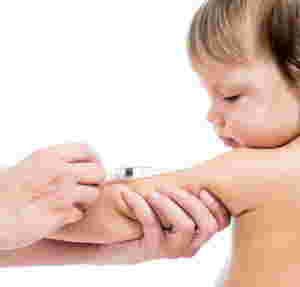
Parents may need a Mantoux test if their little one shows the following symptoms:
- Having a fever for more than 2 weeks and recurring even though it is not high
- Decreased appetite
- Weight does not increase in 2 consecutive months
- The child’s face looks tired and inactive.
- There is a lump on the neck that can be felt
- It is known that there is another TB sufferer in the house and the child is close to him
TB transmission can occur due to phlegm droplets containing germs being inhaled and entering the lungs.
Procedure
This test is done by injecting a small amount of tuberculin solution into the skin on the underside of the arm.
After the injection process, a person who is given a tuberculin skin test must return within 48 to 72 hours so that the doctor can see the reaction.
This action aims to see the body’s reaction to the TB germ protein that has been injected.
If a lump of approximately 10 mm appears at the injection site, the test result can be said to be positive.
If the test results are positive, this indicates that the body has reacted to the tuberculosis germ protein, indicating that the patient has been infected with this germ before.
How to Read Results
If the test results indicate a positive indication that your child has a TB infection, then you must immediately carry out a series of treatments for him.
X-rays may be needed to see how severe your little one’s infection is.
After that, the doctor will prescribe medication that must be taken regularly every day.
Although tuberculosis or TB can be cured, it requires patience from parents in giving medicine to children.
Make sure the medicine is finished so that the disease can be cured completely and keep the house area clean.
Possibility of Positive Result, Even if Actually Negative
According towebsiteAccording to the Centers for Disease Control and Prevention (CDC) , some people may react positively to the Mantoux test even though they are not infected with M. Tuberculosis.
The causes of this false positive reaction include the following:
- Have had previous TB vaccination with the bacille Calmette-Guérin (BCG) vaccine
- Suffering from nontuberculous mycobacterial infections (microbacteria other than M. tuberculosis)
- Incorrect measurement or interpretation of reactions
- Wrong antigen used
Possible Negative Result, Even Though It’s Actually Positive
Not only false positive results, there is also the possibility of false negative results appearing in the Mantoux test.
Some people may not show a reaction to the Mantoux test even though they have been infected with M. Tuberculosis.
The reasons include:
- Energy
- Have had a recent TB infection (in the last 8 to 10 weeks)
- Very young age (less than 6 months)
- Having received a live virus measles or smallpox vaccine recently
- Incorrect method of administering tuberculin solution
- Incorrect measurement or interpretation of reactions
Risk

There is a very small risk of having a severe reaction to the Mantoux test, especially if someone is suffering from tuberculosis (TB).
These allergic reactions can cause swelling and pain in the area where the injection was given.
After injection, a red reaction in the skin test area is normal.
Itching may also occur, but it is important not to scratch, as this can cause redness or swelling which can make it difficult to read the skin test.
If you experience itching, place a cold washcloth on the injection area and then pat dry.
A strong positive reaction may cause mild pain.
Contact a doctor immediately if fever, swelling in the arm, and/or swollen lymph nodes in the armpit occur after performing the Mantoux test.
Alternative Test
Apart from the Mantoux skin test, another alternative way to detect tuberculosis bacterial infection is by doing a blood test.
TB blood test is also calledinterferon-gamma release assaysor IGRA.
To perform this test, the doctor will take a sample of the patient’s blood and send it to a laboratory for analysis.
If a TB blood test shows a positive result, it means the person has been infected with TB bacteria.
Additional tests are needed to determine whether the person has latent TB infection or TB disease.
Meanwhile, if the TB blood test is negative, it means that the person’s blood did not react to the test and there is no possibility of latent TB infection or TB disease.
A TB blood test is usually performed on people who have received the bacille Calmette–Guérin (BCG) TB vaccine.
*** The Mantoux test is carried out as an effort to prevent tuberculosis which can become more severe if it is not immediately detected and treated appropriately.
In addition, this test can also prevent transmission to other family members.
Hopefully this information is useful!
Republished with permission from theAsianParent Indonesia


 Together Against RSV
 Pregnancy
 Parenting
 Child
Child Feeding & Nutrition
 Education
 Lifestyle
 Events
 Holiday Hub
 Aptamil
 TAP Recommends
 Shopping
 Press Releases
 Project Sidekicks
 Community
 Advertise With Us
 Contact Us
 VIP
VIP Rewards
 VIP Parents
