It’s a common fact that most of the world is able to speak more than one language. As parents, we should recognise that in today’s world, you’re better off being bilingual/multilingual. Children who develop the ability to speak more than one language see significant benefits socially and mentally.
Like with so many other traits and learned abilities, a child needs to develop bilingual skills early on in their development. It only gets more and more difficult to absorb the information and nuances of a language as they grow older.
For many families, raising bilingual/multilingual children isn’t necessarily a difficult task. A lot of parents are more than capable of teaching the nuances of more than one language to their children. But there are a few questions that need to be answered pertaining to the topic: Who speaks what? And when? What language should you speak at home? etc.
Recently, The Huffington Post shared six studies backed by informative research that can help you to answer and understand the questions, concerns, and importance of raising children in a bilingual/multilingual home.
Here’s what they found:
Raising bilingual children
1. Two home languages (one parent, one language)
A Spanish-speaking mother and an English-speaking father in the United States.

In this model, it is important for one of the parents’ native languages to reflect the language spoken in the community, so that it can be reinforced in the child.
2. Non-dominant home language (one language, one environment)
Korean-speaking parents in an English-speaking area of the United States.
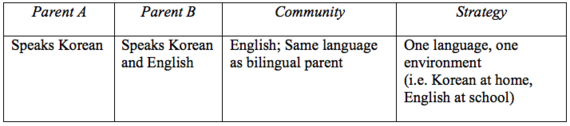
Because Korean is used at home, the child needs early exposure to English outside the home (e.g. in nursery school, in the neighbourhood, with extended family).
3. Non-dominant home language without community support
Cantonese-speaking parents in a Chinese community in the United States.
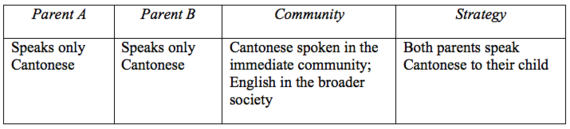
This model is most common among immigrant families. The child will require support as they learn English in school.
4. Double non-dominant home language without community support
A Brazilian mother (Portuguese-speaking) and Haitian father (Haitian Creole-speaking) living in a migrant neighborhood in the United States where Portuguese and Haitian Creole are used.
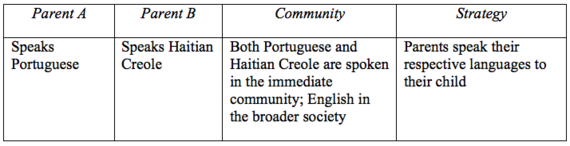
The child will require support as they learn English in school.
5. Non-native language used by one parent
Both parents speak English and the mother uses her second language, Tagalog, with the child in the United States.
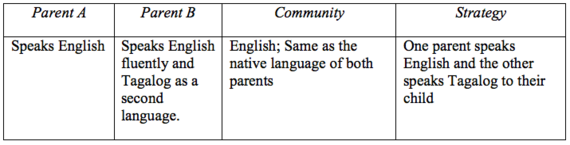
The child will benefit from early Tagalog support from outside the home (e.g. in a Tagalog-speaking nursery, with extended family, in community-based programs).
6. Language mixing and code-switching
Both parents speak English and Hindi and reside in a community where Hindi and English are used interchangeably in the United States.
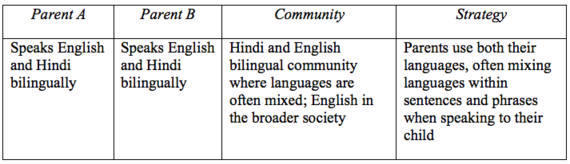
A child’s peer group is very important. If they have similar linguistic practices and weave languages together when they speak to each other, the likelihood of raising multilingual children is much higher.
Raising children in a multilingual home can be a challenging task if not addressed properly. It requires a lot of strategy, planning, and careful adherence to your long-term goals. There are a number of mental and social benefits on raising a child who can speak a multitude of languages so it’s always important for parents to consider teaching their children at a young age, and sticking to your plans.
If you have any insights, questions or comments regarding the topic, please share them in our Comment box below.


 Together Against RSV
 Pregnancy
 Parenting
 Child
Child Feeding & Nutrition
 Education
 Lifestyle
 Events
 Holiday Hub
 Aptamil
 TAP Recommends
 Shopping
 Press Releases
 Project Sidekicks
 Community
 Advertise With Us
 Contact Us
 VIP
VIP Rewards
 VIP Parents
