“My child is sick, he often makes a grok-grok sound, it doesn’t go away. After being checked, it turns out he has laryngomalacia,” said one of Mother M’s stories on theAsianparent Application.
The mother initially felt suspicious because her baby had difficulty gaining weight. Moreover, when he was 1 month old, the little one was treated in the NICU because he had pneumonia.
“Has anyone ever had a child with laryngomalacia? Until the chest is sunken in. Birth weight 2.5 now 4 months old weight 4.1 kg hard to gain weight,” he said again.
What is Laryngomalacia?
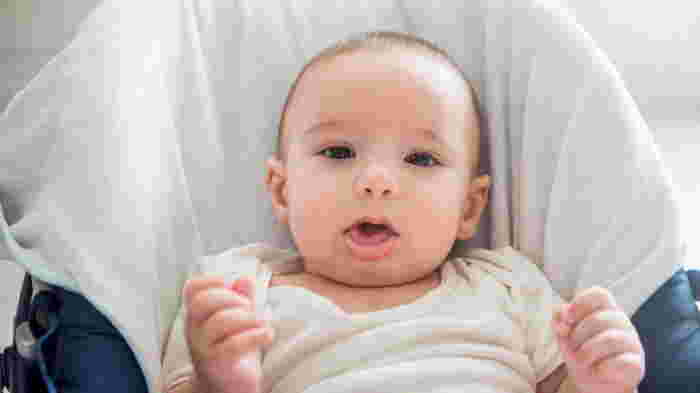
Parents,Be aware of the various symptoms of laryngomalacia in babies
Quoting fromCleveland Clinic, laryngomalacia is a type of voice box disorder that occurs in newborns. This condition is congenital, meaning it is present at birth.
Laryngomalacia occurs when the tissue that lies over the voice box droops and falls back over the airway. Laryngomalacia is the most common cause of noisy breathing in infants.
This condition is also sometimes referred to as Laryngeal Stridor. Stridor is a high-pitched sound that is heard when breathing. This high-pitched sound occurs due to weakness of the tissue above the vocal cords (supraglottic larynx).
Laryngomalacia occurs mostly in infants. Laryngomalacia in adults is very rare, but can occur.
Parents , this condition is apparently a congenital disorder that causes disruption or delay in the growth of laryngeal tissue. This can result in the surrounding tissues becoming weak and partially closing the airway.
The severity of this condition in infants can vary. In most cases, it is not a serious thing because there is usually a chance that the larynx will grow over time.
According to Dr. Delvira Parinding, approximately 90% of cases of this disease can improve when the child is 20-24 months old.
However, in other conditions, laryngomalacia can cause babies to have difficulty eating, breathing, and ultimately causing them to have difficulty gaining weight. As in the case of Bunda M’s baby, proper treatment must be carried out immediately.
Symptom
If your little one has this condition at birth, the symptoms can be more obvious in the first few weeks. On the other hand, most children will experience this condition when they are 18-20 months old.
Some symptoms that can be observed include:
- The sound of his breathing was audible and noisy like a ‘grok-grok’ sound.
- Baby experiences wheezing when breathing
- Breath sounds become worse when the baby is restless, crying, while breastfeeding, or when lying on his back.
- Experiencesleep apnea
- Often draws in the neck and chest every time you breathe
- Blue skin or cyanosis condition
- Having difficulty eating
- Often chokes while eating
- Severe weight gain
- Experiencing gastroesophageal reflux such as vomiting easily
Causes of Laryngomalacia
The exact cause of laryngomalacia is still unknown. Relaxation or lack of muscle tone in the upper airway may be a contributing factor.
Doctors don’t know exactly what causes laryngomalacia, but it may have something to do with how the voice box forms before a baby is born.
The muscles that support the voice box may be weakly formed or not well coordinated with breathing.
This malformation of the voice box can usually be diagnosed immediately at birth or appears within the first month of life.
Gastroesophageal reflux (GE reflux) may contribute to the severity of childhood laryngomalacia symptoms. When the infant is supine or crying, noisy breathing may become worse.
This condition is very common in infants. More than half of all newborns have laryngomalacia during the first week of life, and even more develop it when they are two to four weeks old.
Risk Factors
Some risk factors that play a role in the occurrence of laryngomalacia are as follows:
- GERD
- Neurological abnormalities
- Laryngeal anatomical abnormalities
- Baby boy
Diagnosis
If a child is born with laryngomalacia, symptoms may appear immediately at birth and may become more pronounced in the first few weeks of life.
Laryngomalacia can be diagnosed by history and physical examination based on the baby’s symptoms.
The doctor will ask questions or perform an assessment about the baby’s health problems and may recommend a test called a nasopharyngo laryngoscopy (NPL) to further evaluate the baby’s condition.
This test is done by using a small camera that looks like a strand of spaghetti with a light on the end that is passed through the baby’s nostril and into the lower part of the throat where the larynx is located. This small camera allows the doctor to see the condition of the baby’s voice box.
If laryngomalacia is diagnosed, the doctor may perform other diagnostic tests to evaluate the extent of the child’s problem and to see if the lower airway is affected. These tests may include:
- Neck X-ray
- Airway fluoroscopy
- Microlaryngoscopy and bronchoscopy (MLB)
- Esophagogastroduodenoscopy (EGD) and pH testing
- Functional endoscopic evaluation of swallowing (FEES)
Possible Complications of Laryngomalacia
In most cases, laryngomalacia is a harmless condition that goes away on its own without treatment. It usually improves by the time a child reaches 18 months of age.
There are no long-term complications, but in rare cases a child may experience severe breathing problems that may require surgery or other medical treatment.
WhenParentsNeed to worry?

It is best to contact a doctor immediately if you experience a condition similar to what your child “M” experienced.
In addition, some other symptoms that require immediate medical attention are:
- Lips turned blue and breathing sounded noisy.
- Your little one stops breathing for more than 10 seconds
- The neck or chest appears pulled after being awakened
Treatment and Care
Caring for a Baby with Laryngomalacia
In normal laryngomalacia conditions, surgery is usually not performed. Dr. Delvira said that indeed cases and child growth patterns can vary so they need to be evaluated per person.
However, he said that babies who experience this condition should be given attention to the needs and methods of breastfeeding. Some efforts that can be made include:
- Position your little one upright during breaks from breastfeeding, this is done so that his breathing can be more appropriate.
- Once your little one feels full, it is best not to lay him down straight away to prevent breast milk reflux.
- It’s best to wait for your little one to burp or spit up.
If you have practiced some of the things above, plus your little one shows dangerous symptoms, you should immediately consult a doctor.
When an evaluation is performed and the results show that the condition is affecting growth and development, the doctor will usually consider performing supraglottoplasty surgery .
To diagnose this condition, doctors will usually perform neck X-rays, airway fluoroscopy, Microlaryngoscopy and bronchoscopy (MLB), Esophagogastroduodenoscopy (EGD) and pH probe, and Functional endoscopic evaluation of the swallow (FEES).
Supraglottoplasty Operation

According to Dr. Delvira, the mechanism of this operation is by cutting part of the tissue that is blocking the airway.
However, this operation will not actually completely eliminate noisy breathing.
Some conditions will be helped, such as:
- Improve your little one’s swallowing ability
- Reduces the possibility of apnea or stopped breathing
- Helps increase children’s weight
- Reduce the severity of other symptoms
Laryngomalacia Prevention
Because laryngomalacia is a genetic condition, there is currently no known way to prevent it from occurring.
In most cases, laryngomalacia will go away on its own by the time the baby is one year old.
***
Well, Parents , from the case experienced by Mother M, we should be alert and respond quickly. If your little one experiences various symptoms of laryngomalacia as above, you should immediately check with a doctor. Hopefully this information is useful!
Republished with permission from theAsianparent Indonesia


 Together Against RSV
 Pregnancy
 Parenting
 Child
Child Feeding & Nutrition
 Education
 Lifestyle
 Events
 Holiday Hub
 Aptamil
 TAP Recommends
 Shopping
 Press Releases
 Project Sidekicks
 Community
 Advertise With Us
 Contact Us
 VIP
VIP Rewards
 VIP Parents
