TAP top app download banner
theAsianparent
theAsianparent
Product Guide
  • Together Against RSV
  • SG60
  • Pregnancy
  • Parenting
  • Child
  • Feeding & Nutrition
  • Education
  • Lifestyle
  • Events
  • Holiday Hub
  • Aptamil
  • TAP Recommends
  • Shopping
  • Press Releases
  • Project Sidekicks
  • Community
  • Advertise With Us
  • Contact Us
  • VIP
Login
    • Articles
  • Together Against RSVTogether Against RSV
  • SG60SG60
  • PregnancyPregnancy
  • ParentingParenting
  • ChildChild
  • Feeding & NutritionFeeding & Nutrition
  • EducationEducation
  • LifestyleLifestyle
  • EventsEvents
  • Holiday HubHoliday Hub
  • AptamilAptamil
  • TAP RecommendsTAP Recommends
  • ShoppingShopping
  • Press ReleasesPress Releases
  • Project SidekicksProject Sidekicks
  • CommunityCommunity
  • Advertise With UsAdvertise With Us
  • Contact UsContact Us
  • VIPVIP
    • Community
  • Poll
  • Photos
  • Food
  • Recipes
  • Topics
  • Read Articles
    • Tracker
  • Pregnancy Tracker
  • Baby Tracker
    • Rewards
  • RewardsRewards
  • Contests
  • VIP ParentsVIP Parents
    • More
  • Feedback

Privacy PolicyCommunity GuidelinesSitemap HTML

Download our free app

google play store
app store

6 effective tips and tricks for raising bilingual children

3 min read
6 effective tips and tricks for raising bilingual children

These studies and research will help you to raise bilingual/multilingual children the right way

It’s a common fact that most of the world is able to speak more than one language. As parents, we should recognise that in today’s world, you’re better off being bilingual/multilingual. Children who develop the ability to speak more than one language see significant benefits socially and mentally.

Like with so many other traits and learned abilities, a child needs to develop bilingual skills early on in their development. It only gets more and more difficult to absorb the information and nuances of a language as they grow older.

For many families, raising bilingual/multilingual children isn’t necessarily a difficult task. A lot of parents are more than capable of teaching the nuances of more than one language to their children. But there are a few questions that need to be answered pertaining to the topic: Who speaks what? And when? What language should you speak at home? etc.

Recently, The Huffington Post shared six studies backed by informative research that can help you to answer and understand the questions, concerns, and importance of raising children in a bilingual/multilingual home.

Here’s what they found:

Raising bilingual children

1. Two home languages (one parent, one language)

A Spanish-speaking mother and an English-speaking father in the United States.

2016-03-28-1459185571-3838780-Model1.png

In this model, it is important for one of the parents’ native languages to reflect the language spoken in the community, so that it can be reinforced in the child.

2. Non-dominant home language (one language, one environment)
Korean-speaking parents in an English-speaking area of the United States.
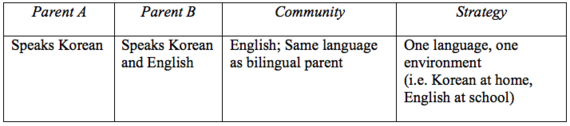
2016-03-28-1459185620-1979144-Model2.png

Because Korean is used at home, the child needs early exposure to English outside the home (e.g. in nursery school, in the neighbourhood, with extended family).

3. Non-dominant home language without community support
Cantonese-speaking parents in a Chinese community in the United States.
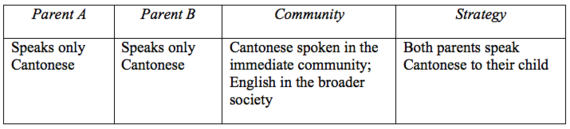
2016-03-28-1459185643-1866104-Model3.png

This model is most common among immigrant families. The child will require support as they learn English in school.

4. Double non-dominant home language without community support
A Brazilian mother (Portuguese-speaking) and Haitian father (Haitian Creole-speaking) living in a migrant neighborhood in the United States where Portuguese and Haitian Creole are used.
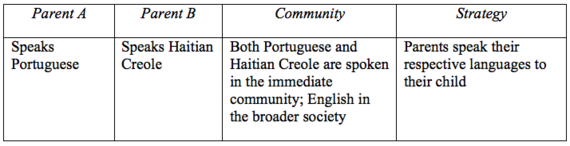
2016-03-28-1459185662-6863270-Model4.png

The child will require support as they learn English in school.

5. Non-native language used by one parent
Both parents speak English and the mother uses her second language, Tagalog, with the child in the United States.
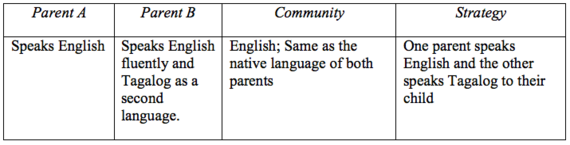
2016-03-28-1459185686-7849410-Model5.png

The child will benefit from early Tagalog support from outside the home (e.g. in a Tagalog-speaking nursery, with extended family, in community-based programs).

6. Language mixing and code-switching
Both parents speak English and Hindi and reside in a community where Hindi and English are used interchangeably in the United States.
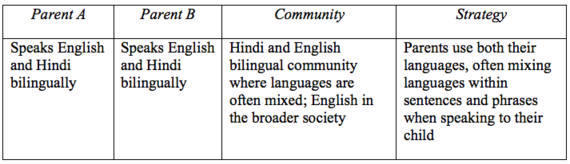
2016-03-28-1459185731-5607284-Model6.png

A child’s peer group is very important. If they have similar linguistic practices and weave languages together when they speak to each other, the likelihood of raising multilingual children is much higher.


Raising children in a multilingual home can be a challenging task if not addressed properly. It requires a lot of strategy, planning, and careful adherence to your long-term goals. There are a number of mental and social benefits on raising a child who can speak a multitude of languages so it’s always important for parents to consider teaching their children at a young age, and sticking to your plans.


If you have any insights, questions or comments regarding the topic, please share them in our Comment box below.

Partner Stories
Unlocking Financial Independence for the Next Generation
Games to Play With Kids Indoors: 8 Fun Games You Can Play When You're Too Tired to Move
How Stokke Products Can Be The Second-Best Gift To Parents After Giving Birth?
What to Expect the First 24 Hours After Giving Birth

Got a parenting concern? Read articles or ask away and get instant answers on our app. Download theAsianparent Community on iOS or Android now!

img
Written by

Santiago Santa Cruz

  • Home
  • /
  • Parenting
  • /
  • 6 effective tips and tricks for raising bilingual children
Share:
  • DeRAMA: Honouring motherhood through transformative postpartum care

    DeRAMA: Honouring motherhood through transformative postpartum care

  • Festive Buffets the Whole Family Will Love (Yes, Even the Kids)

    Festive Buffets the Whole Family Will Love (Yes, Even the Kids)

  • From Arcades to Cyberspace: Where Teens Hang Out Has Changed. Here’s How Parents Can Keep Them Safe

    From Arcades to Cyberspace: Where Teens Hang Out Has Changed. Here’s How Parents Can Keep Them Safe

  • DeRAMA: Honouring motherhood through transformative postpartum care

    DeRAMA: Honouring motherhood through transformative postpartum care

  • Festive Buffets the Whole Family Will Love (Yes, Even the Kids)

    Festive Buffets the Whole Family Will Love (Yes, Even the Kids)

  • From Arcades to Cyberspace: Where Teens Hang Out Has Changed. Here’s How Parents Can Keep Them Safe

    From Arcades to Cyberspace: Where Teens Hang Out Has Changed. Here’s How Parents Can Keep Them Safe

Feed

Feed

Get tailored articles about parenting, lifestyle, expert opinions right at your fingertips

Poll

Poll

Participate in interesting polls and see what other parents think!

Photos

Photos

Share the photos of loved ones in a safe, secure manner.

Topics

Topics

Join communities to bond with fellow mums and dads.

Tracker

Tracker

Track your pregnancy as well as baby’s development day-by-day!

theAsianparent

Download our free app

Google PlayApp Store

Mums around the world

Singapore flag
Singapore
Thailand flag
Thailand
Indonesia flag
Indonesia
Philippines flag
Philippines
Malaysia flag
Malaysia
Vietnam flag
Vietnam

Partner Brands

Rumah123VIP ParentsMama's ChoiceTAP Awards

© Copyright theAsianparent 2026 . All rights reserved

  • About Us
  • Privacy Policy
  • Terms of Use
  • Sitemap HTML
  • Tools
  • Articles
  • Feed
  • Poll

We use cookies to ensure you get the best experience. Learn MoreOk, Got it

We use cookies to ensure you get the best experience. Learn MoreOk, Got it