The sense of hearing is one of the vital organs that everyone has, including babies. By hearing, babies can respond to sounds and use their reflexes. However, what if the baby is not surprised by loud sounds?
Hearing loss can occur at any age. However, hearing loss present at birth or that develops in infancy and toddlerhood is of particular concern to parents and pediatricians. This is because it can lead to developmental challenges if not recognized and treated early.
Hearing loss is one of the most common birth defects. Although most babies are born with perfect hearing, about 1 in every 1,000 healthy babies is born with a hearing loss, according to the WHO.
Reasons Why Babies Are Not Startled by Loud Noises
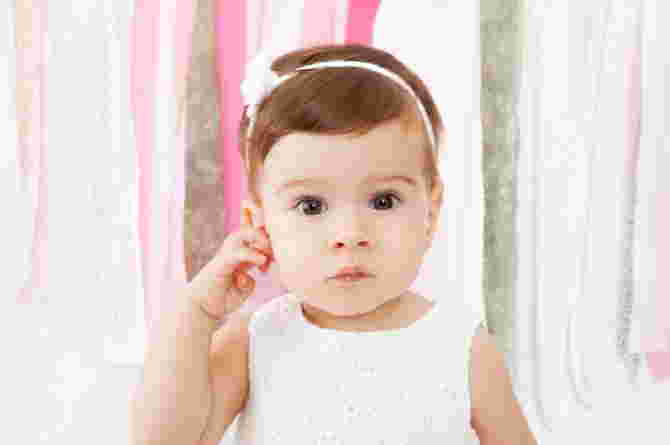
Babies who are not startled by loud noises may have mild hearing loss, where the baby can hear some sounds, but not soft speech. There are also babies who have an inability to hear any sounds. Babies who need to be admitted to the neonatal intensive care unit are at higher risk for hearing loss.
There are four types of hearing loss, namely:
- Conductive hearing loss: This is caused by structural abnormalities in the outer ear canal or middle ear, or fluid in the middle ear that prevents sound from traveling properly. This type of hearing loss is usually mild, can be temporary, and can be treated with medication or surgery.
- Sensorineural hearing loss: This is usually the result of a structural problem or damage to the inner ear (cochlea) or the nerves that send signals to the brain. Sensorineural hearing loss is usually present at birth, can be inherited, and is usually permanent.
- Mixed hearing loss: Some babies have both conductive and sensorineural hearing loss.
- Auditory neuropathy spectrum disorder: Children with this condition can hear or detect sounds with their ears, but there is a problem with the inner ear that sends sounds to the brain. The ears and brain don’t coordinate well enough to process sounds normally. This can make it difficult to distinguish sounds and understand speech.
Here are some things that can increase the possibility of a baby not being startled by loud noises, namely:
Genetics
About 1 in 2 cases of hearing loss in babies are caused by genetic factors . Some babies with genetic causes for their hearing loss may have family members who also have hearing loss.
About 1 in 3 babies with genetic hearing loss have a “syndrome.” This means they have another condition in addition to the hearing loss, such as Down syndromeor Usher syndrome.
Pregnancy and Childbirth Problems
Meanwhile, 1 in 4 cases of hearing loss in babies are caused by maternal infections during pregnancy, complications after birth, and head trauma. For example, children:
- Having an infection, such as before birth or while in the womb
- Spending 5 days or more in a hospital’s neonatal intensive care unit (NICU) or having complications while in the NICU.
- Special procedures such as blood transfusions are needed to treat severe jaundice .
- Having a head, face or ears that are shaped differently than a normal baby
- Having a condition such as a neurological disorder that may be associated with hearing loss
- Having an infection around the brain and spinal cord or what is commonly called meningitis
- Suffered a serious head injury that required hospitalization.
Some children are born with hearing loss due to low birth weight or premature birth.
Abnormal Development of the Inner Ear
This can happen due to birth defects.
Injury, Tumor or Infection
These can all damage the nerves in the baby’s inner ear. Infections that can cause damage include chickenpox, flu, meningitis , or mononucleosis.
Drugs
Some types of medications, such as chemotherapy, salicylates, loop diuretics, and certain intravenous antibiotics can also cause hearing loss.
Fluid Retained in the Middle Ear
Fluid may be present at birth or may develop after an infection or due to poor ventilation in the ear. Fluid can remain in the ear for weeks, even after the infection has cleared. This can cause temporary hearing loss until the fluid is removed or surgically removed. It is difficult to hear through a fluid-filled ear.
Permanent hearing loss from ear fluid is rare, but it is important to seek medical attention for ear infections and middle ear fluid. If a baby has fluid that affects their hearing, it may be difficult for them to meet developmental milestones related to speech and language.
Recurrent Ear Infections
If your baby has recurrent ear infections or middle ear fluid, your baby’s doctor should recommend a hearing test. If this doesn’t happen, ask for a hearing test to make sure your baby is hearing well. Your doctor may also recommend inserting a tube into your baby’s eardrum so that any fluid that has built up behind it can drain.
Dirt and Foreign Objects
Earwax and foreign objects in the ear can also cause a baby to not be startled by loud sounds temporarily. For about 1 in 4 babies born with hearing loss, the cause is unknown.
Symptoms of Hearing Loss in Babies
The best way to know if your baby has hearing loss is to have a hearing screening. However, parents also need to be aware of warning signs or symptoms if their baby is experiencing hearing loss.
Signs of hearing loss can be different for different babies, and the degree of hearing loss can vary. To find out the symptoms, generally it can be seen as follows.
Newborn to 3 Months
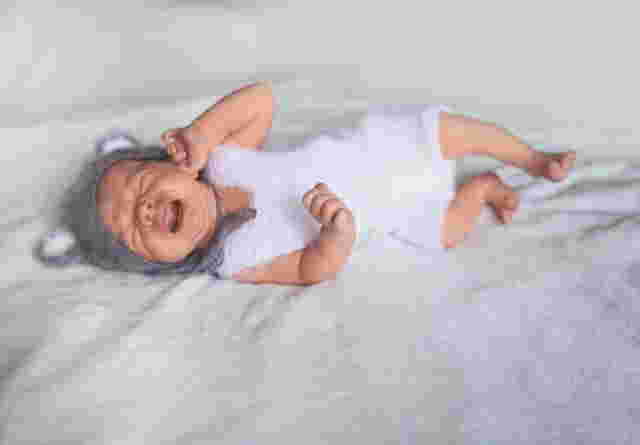
Symptoms of hearing loss can be seen in newborn babies up to 3 months old, if:
- Not startled in response to sudden loud noises
- Not responding to sounds, music, or voices
- Can’t be calmed by a gentle voice
- Not moving or waking up when hearing sounds or noises around when sleeping in a quiet room
- Does not make vowel sounds like “ohh” by 2 months of age
- Not being calmed by hearing familiar voices
Baby 4 to 8 Months
Symptoms of hearing loss at this age are almost the same as at previous ages, ranging from:
- Not turning their heads or eyes toward sounds they cannot see
- Does not change expression when hearing loud sounds or voices when in a quiet place
- Doesn’t seem to like shaking toys, ringing bells, or pressing noisemakers.
- At 6 months, does not try to imitate sounds
- Haven’t started babbling to themselves or talking back to others who are talking to them
- Not responding to “no” and changes in tone of voice
- Seems to hear some sounds but not others
- Seems to notice vibrating sounds (which can be felt) but not just heard ones.
Baby 9 to 12 Months
At this age, signs or symptoms of hearing loss include:
- Do not turn quickly or directly towards the maker of a soft or “quiet” noise.
- Not responding to their name
- Does not vary pitch when babbling
- Does not make some different consonant sounds when babbling (m, p, b, g, etc.)
- Does not respond to music by listening, swaying, or singing along
- At 1 year, does not say any words, such as “dada” and mama”
- At 1 year of age, there are not many distinct pronunciations of consonants at the beginning of words such as b, m, and d.
- Does not understand words for common items (such as “shoes”), expressions (such as “see you later”), or commands (such as “come here”).
What Mothers Should Pay Attention To
There are several things that mothers need to pay attention to so that the incident of their baby not being shocked by hearing a loud noise does not happen to their little one, namely by taking early preventive measures, such as:
1. Prevention Before and During Pregnancy
- Get regular checkups. Preconception checkups help ensure you are healthy before you get pregnant. Once you are pregnant, get regular prenatal care so any problems can be detected and treated early.
- Protect yourself from infections. Make sure your vaccinations are up to date, so you are not susceptible to preventable diseases. Get tested for sexually transmitted diseases before pregnancy, and practice safe sex. Wash your hands regularly.
2. Prevention After Baby is Born
- Never insert anything into a baby’s ear canal. Even cotton swabs can cause damage.
- Immunize babies against childhood diseases, as some of them, such as mumps, can cause hearing loss.
- Monitor your baby for colds and ear infections. If your baby shows signs of an ear infection, talk to your doctor.
- Don’t expose your baby to loud noises, especially continuous noises. If you have to raise your voice to be heard above the noise, it’s too loud. Carpets and rugs help soften the noise in the room.
In the meantime, most hospitals screen newborns for hearing before they are allowed to go home. Several hearing tests may be performed on newborns, each taking only five to ten minutes. If your baby is not seen at the hospital, ask your doctor about having their hearing screened as early as possible within the first month.
Sometimes hearing loss develops later in life. Parents and caregivers are often the first to notice when a baby isn’t hearing well, so pay attention if your baby doesn’t startle at loud noises and let your doctor know right away.
If the hospital or doctor suspects that your baby has a hearing loss, they will likely be referred to a pediatric audiologist (hearing specialist). This specialist will perform a comprehensive hearing evaluation, which may include playing sounds to see how your baby reacts. The types of hearing tests for children include:
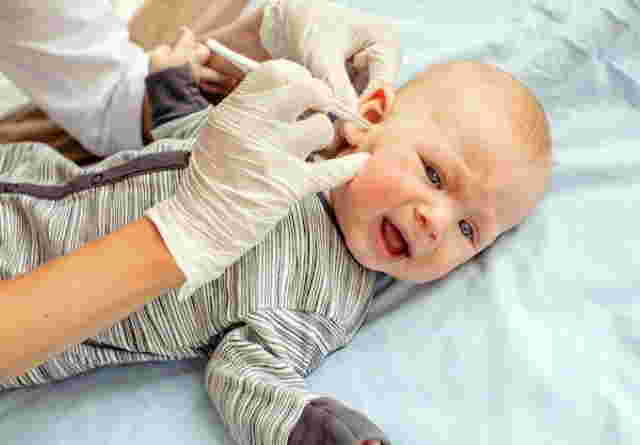
Auditory brainstem & otoacoustic emission testing
If a child under 6 months old is unable to cooperate or understand the hearing screening or has significant developmental delays, they may be given one of two available tests. These are similar to the tests performed during a newborn hearing screening. They are painless and can last anywhere from five minutes to an hour.
- Auditory brainstem response (ABR) test
This test measures how the brain responds to sounds during deep sleep. Clicks or tones are played into the baby’s ears through soft earphones, and electrodes placed on the baby’s head measure the brain’s response. ABR is performed during natural sleep in babies younger than three or four months. Older babies and toddlers need to be sedated for ABR.
- Otoacoustic emission (OAE) test
This test measures the sound waves produced by the ear. A small probe is placed just inside the baby’s ear canal, which then measures the response when a click or tone is played into the baby’s ear. Babies and young children usually do not need to be napped or sedated for this short screening test. It can be done at any age.
Behavioral audiometry
Behavioral audiometry or conditioned response audiometry can be performed on infants as young as six months. This test uses a combination of visual and auditory stimuli. It can determine frequency-specific hearing levels in infants and toddlers.
Formal behavioral audiometry can determine hearing levels as well as eardrum function in each ear. This is done using soft earphones that transmit sounds and words into the ear. It is usually well tolerated by children in the three to five year age range.
If these tests find that your baby may have hearing loss, a more thorough hearing evaluation should be performed as soon as possible to confirm the diagnosis. Even mild hearing loss can affect overall hearing and should be diagnosed and treated properly.
The best time for children with hearing loss to receive help is before they are 6 months old. The sooner a child with hearing loss is diagnosed and treated, the more likely they are to meet the developmental milestones of spoken communication.
Treatment for infant hearing loss also varies. Starting from giving medicines, using hearing aids, therapy, to surgery. It all depends on the condition experienced by the baby.
Ray Tsai, MD, president and chief medical officer of Children’s Health Pediatric Group in Dallas, says that talking, reading, and singing to your baby can help build their personality, encourage language development, and promote bonding. Try using a singing voice to get your baby used to different tones and patterns of speech. You can also let your baby experience the sounds of everyday life and describe to him what he’s hearing. For babies who have trouble sleeping, turn on a white-noise machine , which may be soothing because it replicates the low, steady sounds of the womb.
In essence, if your baby is not surprised by loud noises or experiences some symptoms of hearing loss, parents should be concerned and immediately take them to the doctor.
Hopefully the information above is useful!
***
Republished with permission from theAsianParent Indonesia


 Together Against RSV
 Pregnancy
 Parenting
 Child
Child Feeding & Nutrition
 Education
 Lifestyle
 Events
 Holiday Hub
 Aptamil
 TAP Recommends
 Shopping
 Press Releases
 Project Sidekicks
 Community
 Advertise With Us
 Contact Us
 VIP
VIP Rewards
 VIP Parents
